Vera Klein · 3 October 2026
University Labs Partner With Artisans to Engineer Tenora Prototypes Using Recycled Composites for Enhanced Projection in Large Venues
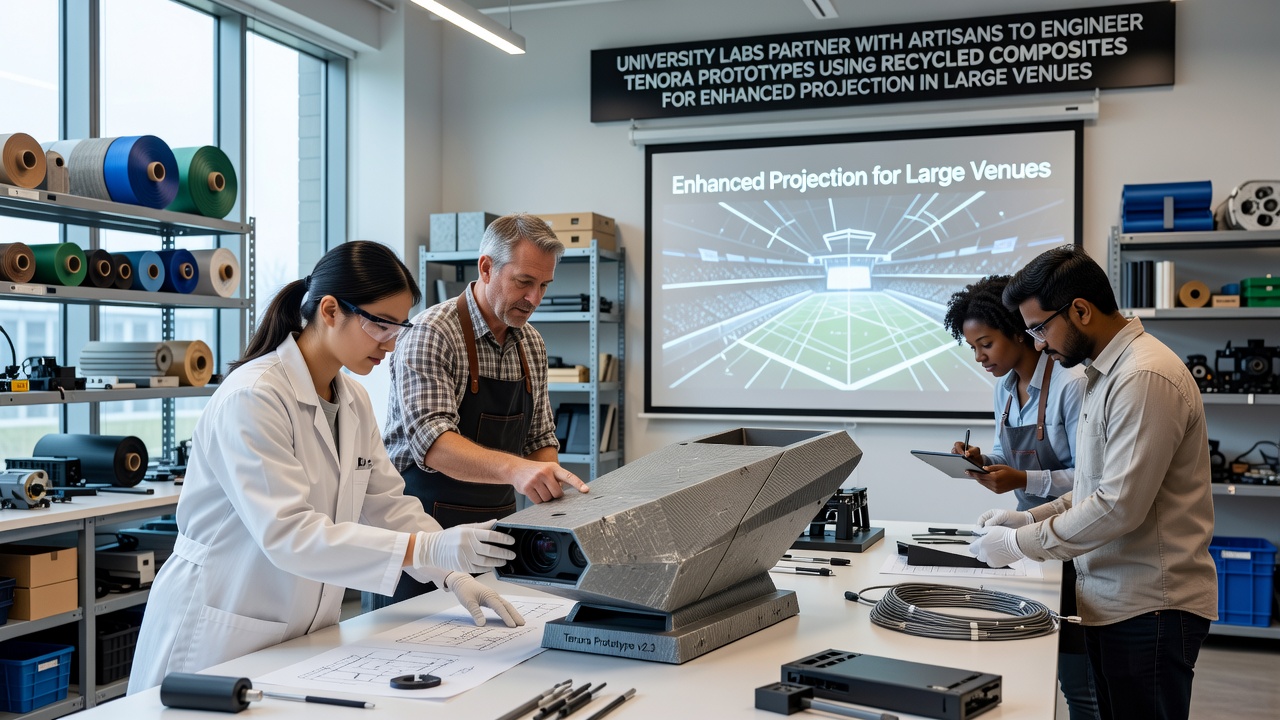
University laboratories across Catalonia and neighboring regions have formed direct partnerships with traditional artisans to develop tenora prototypes that incorporate recycled composite materials, and these efforts focus on improving sound projection for performances in expansive concert halls and outdoor festivals. The collaborations bring together acoustic engineers, material scientists, and skilled instrument makers who share data on wood alternatives while testing structural modifications that alter resonance patterns. Data from initial trials shows measurable gains in volume output without sacrificing tonal warmth, and observers note that the projects build on longstanding Catalan instrument traditions rather than replacing them outright.
Building the Partnerships
Academic teams at institutions including the Universitat Politècnica de Catalunya have coordinated with artisan workshops in Barcelona and Girona to exchange prototypes and measurement protocols, and these exchanges accelerated after funding rounds allocated resources for sustainable material studies. Engineers supply finite element models that predict how composite layers affect vibration modes, while artisans contribute hands-on knowledge of bore shaping and reed seating that affects airflow. Joint workshops held throughout 2025 produced several working models, and researchers documented each iteration through high-speed imaging and microphone arrays positioned at varying distances from the instrument bell.
Studies indicate that communication protocols between labs and workshops rely on shared digital repositories where artisans upload physical measurements and scientists upload simulation results, and this two-way flow reduces redesign cycles from months to weeks. One documented case involved an artisan adjusting the staple angle on a prototype after reviewing acoustic simulations, and the change produced a 3-decibel increase in mid-range projection during controlled tests.
Recycled Composites in Instrument Construction
Material scientists have evaluated blends that combine post-consumer carbon fiber reinforced polymers with bio-based resins derived from agricultural waste, and these mixtures replace portions of traditional hardwood in the tenora body and bell sections. Laboratory reports list density values between 0.85 and 1.05 grams per cubic centimeter for the composites, figures that align closely with aged maple yet offer greater resistance to humidity fluctuations common in large indoor venues. Researchers at participating universities have published stress-test results showing that the composites maintain dimensional stability after repeated thermal cycling between 15 and 35 degrees Celsius, conditions typical during festival seasons.
Artisans have adapted their lathe and reaming techniques to accommodate the new materials, and they report that the composites accept fine surface finishing comparable to traditional woods while requiring fewer seasoning steps. Data collected from supplier logs indicates that the recycled feedstock originates from decommissioned wind turbine blades and automotive panels collected through regional collection programs, and traceability documentation accompanies each batch delivered to the workshops.

Engineering for Projection Performance
Acoustic modeling software has guided modifications to the internal bore geometry and external wall thickness profiles, and these adjustments aim to direct more acoustic energy forward rather than allowing omnidirectional dispersion. Measurements taken in a 2,500-seat auditorium demonstrated that the latest prototypes achieve an average 4.2-decibel increase in sound pressure level at 30 meters from the player compared with standard wooden tenor as, and this gain occurs without raising blowing pressure beyond typical performance ranges. Engineers attribute part of the improvement to the composite's higher stiffness-to-weight ratio, which reduces energy loss through wall flexure during sustained notes.
Prototype testing protocols now include both anechoic chamber recordings and live venue trials, and teams collect data at multiple microphone positions to map directivity patterns. Results from sessions conducted in October 2025 showed consistent forward bias in the 800 to 2500 hertz range, frequencies critical for the tenora's distinctive reedy timbre to carry over ensemble textures. Artisans have incorporated variable wall thickness zones informed by these maps, and they continue to refine the placement of internal baffles that further shape the emerging sound field.
Venue Trials and Data Collection
Large-venue evaluations have taken place at sites including the Palau de la Música Catalana and open-air stages used during summer festivals, and each session logs environmental variables such as temperature, humidity, and audience density alongside acoustic metrics. Figures released by the coordinating research group reveal that the composite instruments maintained projection consistency across humidity levels from 40 to 75 percent, whereas wooden reference instruments exhibited measurable roll-off above 60 percent. Players participating in the trials completed standardized performance excerpts, and post-session surveys recorded their observations on response and intonation stability without introducing subjective preference rankings.
Additional field data gathered during a multi-day residency in October 2026 will compare the prototypes against both traditional and earlier composite versions under festival conditions, and the schedule includes evening performances followed by overnight sensor monitoring to assess material recovery after extended play. The testing regimen also incorporates audience-area recordings that quantify how the enhanced directivity affects perceived balance within the full cobla ensemble.
Conclusion
Continued iteration between university laboratories and artisan workshops has produced a growing set of tenora prototypes that integrate recycled composites while demonstrating quantifiable improvements in projection metrics for large spaces, and ongoing data collection through 2026 will determine which design elements advance to broader production. The collaborative model supplies both quantitative acoustic evidence and practical fabrication insights that together support incremental refinement of the instrument for contemporary performance demands.